
Electrical Contractor License in Maharashtra
Last Updated: 11 August 2026
Electrical Contractor License in Maharashtra | Complete Guide to the Application Process

- ABOUT
If you want to take up electrical installation, wiring or maintenance work anywhere in Maharashtra, whether that is Mumbai, Pune, Thane,
Nagpur or a village in Kalyan taluka, you need an Electrical Contractor License. Working without one is an offence under Section 146 of the
Electricity Act, 2003, with imprisonment up to 3 months, a fine up to Rs 1,00,000, or both.
Here is the license in one line: a single license issued by the Maharashtra Electrical Licensing Board, government fee Rs 2,500, validity 3 years,
applied for in Form-N after a mandatory name approval step. Maharashtra runs one of the most process-heavy licensing systems in the
country, and most websites writing about it have clearly never handled an actual application. They copy generic content about Class A and
Class B licenses and miss the real process entirely.
We have processed these registrations, seen the actual government challans and approval letters, and this guide walks you through the
process the way it actually happens on the ground. If you would rather hand the whole file to someone who has done it before, our team
handles Maharashtra applications end to end.
Does Maharashtra Have Class A, B or C Electrical Licenses?
No. The Maharashtra Electrical Contractor License issued under the 2017 notification is a single license. There is no Class A, Class B, Super Grade or Class 1, 2, 3 for the contractor license, and the actual license document carries no class marking anywhere.
You will find websites confidently describing a Class A and B system, and other websites just as confidently describing a Super Grade with Classes 1 to 3. Notice that they cannot even agree with each other. The department’s own website simply says that Electrical Contractor, Supervisor and Wireman licenses are issued by the Licensing Board. The grades people half-remember belong to other states such as Uttar Pradesh and Andhra Pradesh, or they confuse the contractor license with the individual Supervisor Competency Certificate.
If a consultant quotes you a higher fee for a “Class A Maharashtra license”, ask them to show one issued license with a class printed on it. We have processed these licenses and seen the documents. There is one license, one fee of Rs 2,500, and one process.
PWD Registration vs the Electrical Contractor License
These two get mixed up constantly, so here is the difference in plain terms. The Electrical Contractor License from the Licensing Board is your legal permission to carry out electrical work anywhere in Maharashtra. PWD contractor registration is a separate empanelment with the Public Works Department that lets you bid on PWD’s own works, and it runs on its own portal with its own contractor classes for civil and allied works.
You do not choose between them. For PWD electrical tenders you typically need both, and the tender documents list the electrical contractor license as a mandatory qualification alongside the PWD registration. MSEDCL, MSETCL and BEST similarly run their own vendor registrations on top of the license. The license comes first in every case, because every one of these registrations asks for your license number.
Who Issues the License in Maharashtra?
The Electrical Contractor License in Maharashtra is issued by the Maharashtra Electrical Licensing Board (Anugyapak Mandal), which functions under the Chief Electrical Inspector, Industries, Energy, Labour and Mining Department, Government of Maharashtra.
The legal framework comes from Regulation 29 of the Central Electricity Authority (Measures relating to Safety and Electric Supply) Regulations, 2010, read with the Maharashtra Electrical Licensing Board Rules, 2017. The state notification governing the whole system is Notification No. Misc. 2016/CR-123/Energy-5 (Marathi: Sankirna-2016/Pr.Kr.123/Urja-5), dated 2 January 2017, published in the Maharashtra Government Gazette on 3 January 2017.
The Licensing Board grants the contractor license in Form-L. In certain jurisdictions the Electrical Inspector grants it in Form-L1. The Secretary of the Licensing Board sits at Chembur, Mumbai, and the department also operates through Superintending Engineers at Pune, Aurangabad and Nagpur for their respective regions.
The official websites you will deal with are ceimah.in for information and downloads, and the Aaple Sarkar portal for the online application.
Who Is Eligible to Apply for an Electrical Contractor License in Maharashtra?
Any individual, partnership firm or company with a Maharashtra business registration and an appointed Electrical Supervisor can apply. There is no separate qualifying examination for the contractor license itself.
- Entity type: individual, partnership firm, or company. All three are accepted.
- Maharashtra business proof: Shop Act (Gumasta), GST with state code 27, or MSME/Udyam with a Maharashtra address. At least one must be Maharashtra-registered.
- Electrical Supervisor: must be appointed before filing, holding a valid Maharashtra Supervisor Competency Certificate and Permit. If the owner holds one himself, he can act as his own supervisor through the Form-L1 route.
- Testing instruments: a Megger and an Earth Tester, owned by the firm, with GST purchase invoices and IS-standard test reports.
- Name approval: obtained from the Licensing Board before the application, valid for 60 working days.
- Authorised signatory: a Power of Attorney holder (Mukhtyar Patra Dharak) with Aadhaar and PAN on record.
- Out-of-state firms: eligible, but must first establish a Maharashtra business presence.
The Part Nobody Tells You - Name Approval Comes First
Here is something you will not find on most websites. Before you file the actual license application, you have to get your firm’s name approved by the department.
You submit a request to the Electrical Inspector (Secretary, Licensing Board) proposing the name under which you want to run your electrical contracting business. You can propose up to three names in order of preference. The department checks availability and issues a Name Approval letter through the Aaple Sarkar portal
The approval letter carries an approval number in the format EISLB/NAME APPROVAL/xxxxx and mentions your firm name in both English and Marathi along with your district.
One critical detail: the name approval is valid for only 60 working days from the date of approval. You must complete and submit your full license application within this window. If you miss it, you go back to square one and apply for name approval again.
This single step is why many self-filed applications fail. People prepare all their documents first, then discover the name approval requirement, and by the time approval comes their instrument test reports or other time-sensitive papers need refreshing.
Hire Your Supervisor Before You Apply - Not After
This is the biggest structural difference between Maharashtra and a state like Delhi, and getting it wrong wastes months.
In Delhi, the contractor license is issued to the firm first, and the firm then hires certified staff before starting work. Maharashtra works the other way around. The Electrical Supervisor must already be appointed before you file the application, and his details go directly into the application forms.
The application requires:
- The supervisor’s full name
- His Supervisor Competency License number (a long numeric format like 1041101234121xxxxx)
- The date his license was issued
- His residential address, mobile number and email
- His photograph and specimen signature on Form-U
- His signature done in front of the Electrical Inspector during verification
The forms also include a mutual undertaking that if either party wants to end the employment, both the contractor and the supervisor will give at least one month’s advance written notice to the Licensing Board. This is a formal declaration, not a casual arrangement.
If the owner of the firm himself holds a valid Supervisor Competency Certificate, he can act as his own supervisor. In that case the license comes under the Form-L1 route through the Electrical Inspector. But if the owner is not a supervisor, hiring one with a valid Maharashtra competency license and permit is compulsory before anything else moves.
Maharashtra Business Proof - Shop Act, GST or MSME
Now for the entity-level requirement that trips up out-of-state applicants.
Your firm must be able to prove that it is a Maharashtra-based business. In practice, the department accepts any of
these three documents as business proof, and at least one of them must be Maharashtra-registered:
- Shop Act License (Gumasta) issued by the local municipal authority in Maharashtra
- GST Registration with a Maharashtra address (state code 27)
- MSME / Udyam Registration showing a Maharashtra unit address
The Prescribed Forms - N, W, U and B
The Maharashtra application is a set of prescribed forms under the 2017 notification. Knowing what each form does
will make the whole process less intimidating.
Form-N is the main application for the Electrical Contractor License. It captures the business name, business address, contact details, entity type (individual, company or partnership), authorised signatory details, age, father’s name, educational qualification, fee payment details, bank account details with balance, previous license history if any, the supervisor’s name and license number, and the list of testing instruments you hold with their make and serial numbers.
Form-W is the affidavit or declaration by the Power of Attorney holder. In it, the authorised person declares that he is the sole POA holder of the firm, that he is not working as an employee or partner in any other company, that the supervisor has been appointed from a specific date, and that the one-month notice arrangement with the supervisor is understood. It also confirms that the applicant has read the terms and conditions under which the license can be suspended or revoked.
Form-U is the verification report. It carries the contractor firm’s details, the POA holder’s photograph, signature, mobile and email on one side, and the supervisor’s details, photograph, license number, address, mobile, email and signature on the other. Both parties sign this in front of the Electrical Inspector (Secretary, Licensing Board), who verifies the original certificates and licenses and records that the signatures were made in his presence. Recent 2 x 2 inch colour photographs with white background are required.
Form-B (Prapatra-B) is the owner’s self-declaration for self-attestation. The owner declares, with his Aadhaar number on record, that all self-attested copies submitted are true copies of the originals, and acknowledges that false copies invite prosecution under the Indian Penal Code.
NOTE: Along with these, a covering application letter addressed to the Electrical Inspector (Secretary, Licensing Board and Lift Inspector), Industries, Energy, Labour and Mining Department, Chembur, Mumbai, goes on top of the file.
Testing Instruments - Buy Them and Get the Test Reports
Maharashtra requires the contractor to possess a Megger (Insulation Tester) and an Earth Tester. These are not optional and the department checks the actual documents.
What you need for each instrument:
Purchase invoice from an instruments dealer, showing your firm’s name, GST number, the instrument make, model and serial number. A typical purchase looks like this: an Omega Earth Tester (0-10/100 Ohms range) for around Rs 2,550 and an Omega Insulation Tester (1000V/200 Megaohms) for around Rs 1,350, plus 18 percent GST. So the total instrument cost comes to roughly Rs 4,600 for both. HSN code 9030 applies to these instruments.
Test report / calibration certificate for each instrument. The Earth Tester must be tested as per IS 9223-1979 and the Insulation Tester as per IS 2992. The test report certifies accuracy, insulation resistance and high voltage test results, and carries the manufacturer’s Quality Control stamp with the testing date. The serial number on the test report must match the serial number on the invoice.
The instrument serial numbers also get entered in Form-N. During verification, mismatched serial numbers between the invoice, the test report and the form are a common reason for objections.
Fees - Rs 2,500 Through GRAS Challan
The application fee for a new Electrical Contractor License in Maharashtra is Rs 2,500. We have seen the actual government challan, so let us put the details on record because several websites quote wrong figures.
The payment goes through the GRAS system (Government Receipt Accounting System) using MTR Form Number-6. The challan details look like this:
- Department: Chief Electrical Inspector
- Type of Payment: Examination fees of Licensing Board (Other Receipts)
- Office Name: Secretary License Board, Chembur, Mumbai
- Account Head: 0043018101 – Examination Fees
- Amount: Rs 2,500
- Remark: New Electrical contractor license fee
Payment can be made online through the GRAS portal via net banking. The system generates a GRN (Government Reference Number) and a bank CIN, and the challan printout goes into your application file.
The license, once issued, is valid for 3 years. Renewal is also for 3-year blocks, and the renewal application in Form-J must reach the Secretary, Licensing Board through the Electrical Inspector of your district before the license expires.
Complete Document Checklist
Here is everything that goes into a Maharashtra Electrical Contractor License file:
- Covering application letter to the Electrical Inspector (Secretary, Licensing Board), Chembur, Mumbai
- Name Approval letter from energy.mahaonline.gov.in (within its 60 working day validity)
- Form-N (main application) fully filled
- Form-W (POA holder’s declaration)
- Form-U (verification report with photos and signatures of owner and supervisor)
- Form-B (self-declaration for self-attestation)
- Business proof: Maharashtra Shop Act License, GST Registration or MSME/Udyam Certificate
- Entity documents: partnership deed, or certificate of incorporation with MOA/AOA and board resolution, as applicable
- Authorisation letter for the authorised signatory (companies and partnerships)
- Aadhaar Card of the POA holder / owner
- PAN Card of the firm and the owner
- Supervisor’s Competency Certificate and Permit (original shown at verification, self-attested copy in file)
- Supervisor’s appointment details with the mutual one-month notice undertaking
- Instrument purchase invoices (Megger and Earth Tester)
- Instrument test reports as per IS 9223-1979 and IS 2992
- Bank account details of the firm with balance
- GRAS challan of Rs 2,500
- Recent 2 x 2 inch colour photographs of the owner and the supervisor, white background
- Office address proof in Maharashtra: electricity bill, registered rent agreement or ownership papers
Step-by-Step Process
The Tender & Licence team follows a structured process for every Electrical Contractor License application in Maharashtra.
Set Up Your Maharashtra Business Base
Register your Maharashtra business proof first. Shop Act, GST with state code 27, or MSME with a Maharashtra address. Without this, nothing else proceeds.
Hire Your Electrical Supervisor
Find a supervisor holding a valid Maharashtra Supervisor Competency Certificate and Permit. Agree on the appointment and document the date. If you yourself hold a supervisor certificate, you can apply through the Form-L1 route as your own supervisor.
Apply for Name Approval
Submit the name approval request through energy.mahaonline.gov.in with up to three proposed names. Wait for the approval letter. Remember the 60 working day clock starts once approval is granted.
Buy Instruments and Collect Test Reports
Purchase the Megger and Earth Tester with proper GST invoices in your firm's name. Collect the IS-standard test reports with matching serial numbers.
Pay the Fee
Generate the GRAS challan (MTR Form-6) for Rs 2,500 under the Chief Electrical Inspector department head and pay online. Keep the printout with GRN.
Fill the Forms and Compile the File
Complete Form-N, Form-W, Form-U and Form-B. Attach every document from the checklist. Paste photographs where required.
Submit and Attend Verification
Submit the file to the Secretary, Licensing Board at Chembur, Mumbai (or through the Superintending Engineer of your region for Pune, Aurangabad and Nagpur regions). Both the owner and the supervisor appear before the Electrical Inspector with original documents. Signatures on Form-U are made in his presence after he verifies the originals.
License Issuance
After scrutiny and verification, the Licensing Board grants the license in Form-L (or Form-L1 through the Electrical Inspector where applicable). The whole cycle from name approval to license typically takes 1 to 3 months depending on how complete your file is and the department's schedule.
How Tender & Licence Helps You Get the Maharashtra Licence?
You can file this application yourself, and this guide gives you the full process. Where files actually get stuck is the sequence: name approval expiring before the file is ready, supervisors appointed without the notice undertaking, instrument serial numbers that do not match across the invoice, test report and Form-N, and out-of-state firms applying without Maharashtra business proof. That sequencing is what we manage.
Our service covers checking your entity and Maharashtra business proof before anything is filed, the name approval request and tracking, supervisor documentation with the mutual notice undertaking, instrument invoices and IS-standard test reports with matching serials, Form-N, W, U and B preparation, the GRAS challan, submission at Chembur or through your regional Superintending Engineer, and follow up until the licence is issued. You appear only where the department requires it, which is the Form-U verification in front of the Electrical Inspector.
The government fee of Rs 2,500 is paid directly to the department. Send us a WhatsApp message with your entity type and district, and we will tell you in one conversation what your file needs. If your licence has expired or is close to the one month cancellation window, mention the expiry date first, because that decides whether renewal or a fresh application applies.
What the Issued License Actually Looks Like?
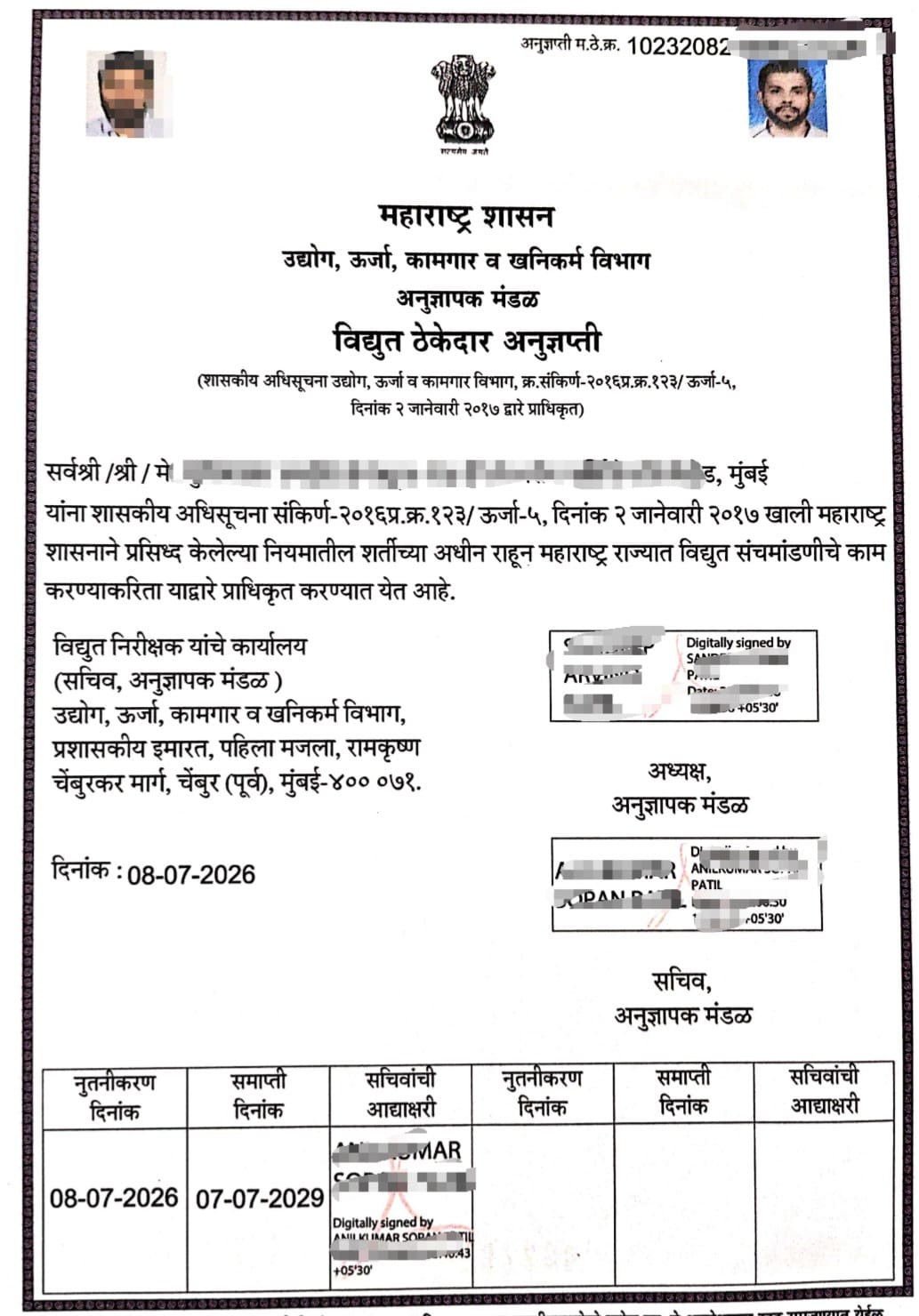
Since we have seen actual licenses issued by the Licensing Board, here is what you receive at the end of the process. Knowing this helps you verify that your license is genuine and complete.
The license is titled Vidyut Thekedar Anugyapti (Electrical Contractor License) and is issued by the Anugyapak Mandal (Licensing Board) under the Industries, Energy, Labour and Mining Department, Government of Maharashtra. It cites the same notification, Notification No. Misc. 2016/CR-123/Energy-5, under which the whole system operates.
A few things stand out on the actual document:
Two photographs are printed on the license itself. The photograph of the owner or Power of Attorney holder appears on one side, and the supervisor’s photograph on the other. This is why the 2 x 2 inch photos submitted with Form-U matter so much.
It carries two digital signatures. The license is digitally signed by both the Adhyaksh (Chairman) and the Sachiv (Secretary) of the Licensing Board, each with a verifiable timestamp. A license without both signatures is incomplete.
The license number is a long numeric string. The Anugyapti number follows a format like 102320824608072026, and this is the number you will quote in tenders, MSEDCL registrations and renewal applications.
A renewal table is printed on the license itself. The document carries columns for Nutanikaran Dinank (renewal date), Samapti Dinank (expiry date) and the Secretary’s initials. Every renewal gets recorded on this table, so the license itself carries its full renewal history.
The validity is exactly 3 years. A license issued on 08-07-2026 shows an expiry of 07-07-2029. This confirms the 3-year cycle in black and white.
Renewal - The One Month Auto-Cancellation Rule
The Maharashtra license runs in 3-year cycles, and there is a hard deadline printed as a note on the license itself that most contractors discover too late.
The license carries this warning: if the license is not renewed within one month from its expiry date, it stands automatically cancelled.
Read that again. You do not get a grace period of a few months, and the department does not send you reminders. Expiry date plus one month, and the license is treated as cancelled on its own. After that, you are back to filing a fresh application with name approval, new forms, verification and all the waiting that comes with it.
For the renewal itself:
- Apply in Form-J before the expiry date, through the Electrical Inspector of your district and the Superintending Engineer of your region, addressed to the Secretary, Licensing Board
- Show that you still possess the Megger and Earth Tester with valid test reports
- Show that a supervisor with a valid competency certificate and permit is still employed (or that you hold one yourself)
- Pay the prescribed renewal fee through GRAS
- On approval, the renewal gets recorded in the renewal table printed on your license
Our advice: put a reminder two to three months before your expiry date. The renewal itself is straightforward when filed on time, and a disaster when the one-month window closes.
Renewal deadline close? Don’t risk auto-cancellation. Send us your licence expiry date on WhatsApp — we will check whether renewal or a fresh application applies in your case, prepare your Form-J, coordinate the Megger/Earth Tester reports, and handle the GRAS fee payment. One conversation, full clarity.
What the License Unlocks in Maharashtra?
Maharashtra is the largest electrical contracting market in the country, and the license is the entry ticket to all of it.
MSEDCL (Mahadiscom), MSETCL and BEST vendor registrations require a valid contractor license. So do Tata Power and Adani Electricity contractor empanelments in Mumbai.
Government tenders from Maharashtra PWD, MIDC, MJP, CIDCO, MMRDA, municipal corporations and smart city projects all list the electrical contractor license as a mandatory qualification document.
Metro and infrastructure work in Mumbai, Pune and Nagpur metro projects flows through licensed contractors only.
Private sector credibility matters too. Builders and industrial clients in MIDC areas verify the license before awarding electrical work, and insurance claims on electrical incidents get scrutinised for whether a licensed contractor executed the installation.
Common Mistakes That Delay or Sink Applications
Skipping name approval. Applying directly with a firm name that was never approved gets the file returned. Name approval is step one, always.
Letting the 60 day window lapse. The name approval expires in 60 working days. Compile your file fast once approval arrives.
Applying without a supervisor. Maharashtra needs the supervisor appointed and documented before the application. His license number goes in the forms.
No Maharashtra business proof. Out-of-state firms applying with home-state GST get rejected. Shop Act, GST or MSME must show Maharashtra.
Serial number mismatches. The instrument serial number must match across the invoice, the test report and Form-N. Even a single digit difference triggers an objection.
Missing the one-month notice undertaking. The mutual undertaking between contractor and supervisor is part of the declaration. Files without it are incomplete.
Old test reports. Instrument test reports should be recent. Reports that are years old may be questioned during verification.
Maharashtra vs Delhi - A Quick Contrast
Since many contractors operate across states, here is how the two systems differ at a glance.
| Maharashtra | Delhi | |
|---|---|---|
| Issuing body | Maharashtra Electrical Licensing Board / Electrical Inspector | Electrical Inspectorate, Labour Department, GNCTD |
| Name approval step | Yes, mandatory, valid 60 working days | No |
| Supervisor hiring | Before application, details go in the forms | After license, before starting work |
| Application fee | Rs 2,500 via GRAS challan | Rs 5,000 via treasury challan or online |
| Validity | 3 years | 25 years |
| License form | Form-L / Form-L1 | Form No-B |
| Business proof | Maharashtra Shop Act / GST / MSME | Delhi Aadhaar and GST rules by entity type |
If you are interested in full state-specific processes, read our full guide on the Electrical Contractor License in Delhi, Electrical Contractor License in UP, Electrical Contractor License in Gujarat.
Contact Us for Electrical Contractor License in Maharashtra
The Tender & Licence team works with applicants across Maharashtra and understands how the Electrical Inspector offices under the Chief Electrical Inspector, Maharashtra actually function, from Mumbai and Navi Mumbai to Pune, Nashik, Nagpur, Chhatrapati Sambhajinagar, Amravati and Kolhapur. Electrical contractor licensing is one of our core services, and we handle fresh applications, renewals, changes in firm details, address or partner changes, and scope upgrades from low and medium voltage work to high tension work.
- Assess your firm and confirm the license scope you actually need before you apply
- Check whether your supervisor certificate of competency and wireman permits are valid, and arrange them if they are not
- Compile the tools, testing instruments and equipment list with photographs in the format the office expects
- Prepare firm documents, partnership deed or incorporation papers, office proof and undertakings
- File the application with the correct divisional Electrical Inspector office for your district
- Prepare you for scrutiny queries and the verification visit so the file does not come back
- Follow up with the office until the license is actually issued in hand
- Handle renewal paperwork and fee deposit, and send reminders before expiry so your license never lapses mid project
Beyond Electrical Contractor License, we also handle licensed Wireman and Supervisor applications, IREPS railway tender registration, UP state tender filing, CPWD vendor registration, and supporting registrations like MSME, Digital Signature, DPIIT, Government Tenders or PSU Contracts, Trademark, GST Registration, ISO and BIS certifications, so an electrical contracting firm can get all the essential registrations and compliance requirements completed through a single consultant.
- Frequently Asked Questions
What is the fee for a new Electrical Contractor License in Maharashtra?
Rs 2,500, paid through a GRAS challan (MTR Form-6) under the Chief Electrical Inspector department head, account head 0043018101 Examination Fees, payable to the Secretary License Board, Chembur, Mumbai. Some websites quote different figures, but this is what the actual government challan shows.
How long is the license valid?
3 years from the date of issue. We have verified this from actual licenses where a license issued on 08-07-2026 shows expiry on 07-07-2029. Renewal is done in Form-J for further 3-year blocks, and if the license is not renewed within one month of expiry, it automatically stands cancelled as per the note printed on the license itself.
What is name approval and is it compulsory?
Yes, it is compulsory and it comes before the license application. You propose up to three firm names, the department approves one through energy.mahaonline.gov.in, and that approval stays valid for 60 working days. Your complete application must be filed within that window.
Do I need to hire a supervisor before applying?
Yes. The supervisor’s name, competency license number, address, photograph and signature go into the application forms themselves. This is the opposite of Delhi, where staff is hired after the license is issued.
Can I be my own supervisor?
Yes. If the owner of the firm himself holds a valid Supervisor Competency Certificate, he can act as his own supervisor. In that case the license comes under the Form-L1 route through the Electrical Inspector.
What business proof does the department accept?
A Maharashtra Shop Act License (Gumasta), a GST registration with Maharashtra address, or an MSME/Udyam registration showing a Maharashtra unit. At least one of these must be Maharashtra-based. Out-of-state registrations alone will not work.
Which instruments are mandatory?
A Megger (Insulation Tester) and an Earth Tester. Each needs a GST purchase invoice in the firm’s name and a test report, the Earth Tester as per IS 9223-1979 and the Insulation Tester as per IS 2992, with serial numbers matching across all documents.
What forms make up the application?
Form-N is the main application, Form-W is the POA holder’s declaration, Form-U is the verification report with photographs and signatures of both owner and supervisor, and Form-B is the self-attestation declaration. A covering letter to the Electrical Inspector goes on top.
Where do I submit the application?
To the Secretary, Licensing Board, office of the Electrical Inspector at Chembur, Mumbai. Applicants from the Pune, Aurangabad and Nagpur regions route their files through the respective Superintending Engineers.
How long does the whole process take?
Realistically 1 to 3 months from name approval to license in hand, assuming the file is complete. Incomplete files, serial number mismatches or expired name approvals stretch this considerably.
Does the owner and supervisor need to appear in person?
Yes. Both sign Form-U in front of the Electrical Inspector, who verifies the original certificates and records that the signatures were made in his presence.
Can a company from another state get a Maharashtra license?
Yes, but it must first establish a Maharashtra business presence, typically through a Maharashtra GST registration, Shop Act license or MSME registration for its Maharashtra office, and then follow the full process including name approval.
What happens if the supervisor leaves?
The declaration filed with the department includes a mutual undertaking that either side will give at least one month’s written notice to the Licensing Board. You must then appoint a replacement supervisor and inform the Board, otherwise the license conditions stand breached.
What is the penalty for working without a license?
Under Section 146 of the Electricity Act, 2003, imprisonment up to 3 months, or a fine up to Rs 1,00,000, or both. Unlicensed contractors are also barred from MSEDCL, PWD and other government tenders.
What happens if I miss the renewal deadline?
The license itself carries a printed note stating that if it is not renewed within one month from the expiry date, it stands automatically cancelled. After auto-cancellation, you must start the entire fresh application process again, including name approval. Set a reminder two to three months before expiry.
How do I verify a Maharashtra electrical contractor license is genuine?
A genuine license carries the photographs of both the owner or POA holder and the supervisor, digital signatures of both the Chairman and Secretary of the Licensing Board with timestamps, a long numeric Anugyapti number, and a printed renewal table recording every renewal with dates and the Secretary’s initials.