
Electrical Contractor Licence in Andhra Pradesh
Last Updated: 20 July 2026

- ABOUT
Electrical Contractor Licence in Andhra Pradesh: Grade A and Grade B
If you carry out electrical installation work in Andhra Pradesh, whether it is building wiring in Vijayawada, a solar park connection in Anantapur, or a 33 KV industrial line near Visakhapatnam, you need a valid Electrical Contractor Licence issued by the A.P. Electrical Licensing Board. Working without one is not a paperwork lapse. DISCOMs cannot legally energise an installation unless a licensed contractor certifies it, so an unlicensed contractor is locked out of both private projects and government tenders.
The rules governing this licence changed in March 2025, and most information available online still describes the repealed 1987 system. This guide is prepared by the Tender & Licence team directly from the Andhra Pradesh Electrical Licensing Rules, 2025 as notified in the official gazette, along with the actual APELB application forms and licence formats, so the fees, timelines and conditions below reflect what the Board actually applies today.
What Is the Electrical Contractor Licence in Andhra Pradesh?
The Electrical Contractor Licence (also searched as electrical contractor license) is the statutory authorisation that permits a person or firm to undertake electrical installation works in the state. It is issued by the Andhra Pradesh Electrical Licensing Board under the Andhra Pradesh Electrical Licensing Rules, 2025, notified through G.O.Ms.No.27, Energy (Power.II) Department, dated 6 March 2025. These rules were framed under Section 180(2)(o) of the Electricity Act, 2003 and Regulation 31 of the Central Electricity Authority (Measures relating to Safety and Electric Supply) Regulations, 2023, and they replace the Andhra Pradesh Electrical Licensing Regulations, 1987 that governed the field for nearly four decades.
The practical force behind the licence sits in one rule: no electricity supplier can connect supply to any new installation, addition or alteration unless a Licensed Electrical Contractor’s completion-cum-test report in Form WR-2 is produced. In other words, every wiring job, panel installation, substation erection or line work in Andhra Pradesh ultimately needs a licensed contractor’s signature before power flows. That applies to work for APEPDCL, APCPDCL and APSPDCL consumers, APTRANSCO contracts, government department tenders, industrial units and private builders alike.
Licensing Authority: A.P. Electrical Licensing Board, Guntur
The licence is granted by the A.P. Electrical Licensing Board (APELB), which functions under the office of the Director of Electrical Safety and Chief Electrical Inspector to Government of Andhra Pradesh. The Director of Electrical Safety and CEIG is the ex-officio Chairman of the Board, and the Electrical Inspector, Guntur is the ex-officio Secretary. All contractor licence applications, renewals and correspondence go to the Secretary at Guntur, and every licence carries the Secretary’s signature and the Board’s seal.
One honest caveat before you plan your application. Unlike states such as Uttar Pradesh where contractor licensing runs through an online portal, the Andhra Pradesh contractor licence process is still a physical, challan-based process. Application forms can be downloaded from the CEIG Andhra Pradesh website (apceig.in), but the filled application, original permit books, treasury challan and enclosures are submitted as a physical file to the Secretary, APELB, Guntur. Only the supervisor and wireman competency examinations are handled online, through the State Board of Technical Education and Training (SBTET AP). Anyone promising a fully online contractor licence for AP is describing a process that does not exist yet.
The New Andhra Pradesh Electrical Licensing Rules, 2025: What Changed?
The 2025 Rules keep the broad structure of the old regime but tighten several points that matter to working contractors:
- The legal foundation shifted from the Indian Electricity Rules era to the CEA (Measures relating to Safety and Electric Supply) Regulations, 2023, which is what inspectors now audit against on site.
- Supervisor and wireman permits are now valid for five years at a time, renewable for further five-year blocks.
- The Board can impose a penalty of up to Rs. 10,000 for incompetence, negligence, malpractice or breach of rules, apart from suspending or cancelling the licence or permit.
- A new debarment provision (Rule 54-A) bars permit holders for 3 years and licence holders for 2 years if they defy Board directions and fail to surrender the permit or licence.
- A consolidated fee schedule was notified, covered in the fee table below.
Licences and permits issued under the 1987 Regulations remain valid under the savings clause, so existing contractors do not need to reapply. They simply renew under the new rules when their current validity ends.
Grade A vs Grade B: Which Licence Do You Need?
Andhra Pradesh issues two grades of electrical contractor licence.
Grade A Electrical Contractor Licence
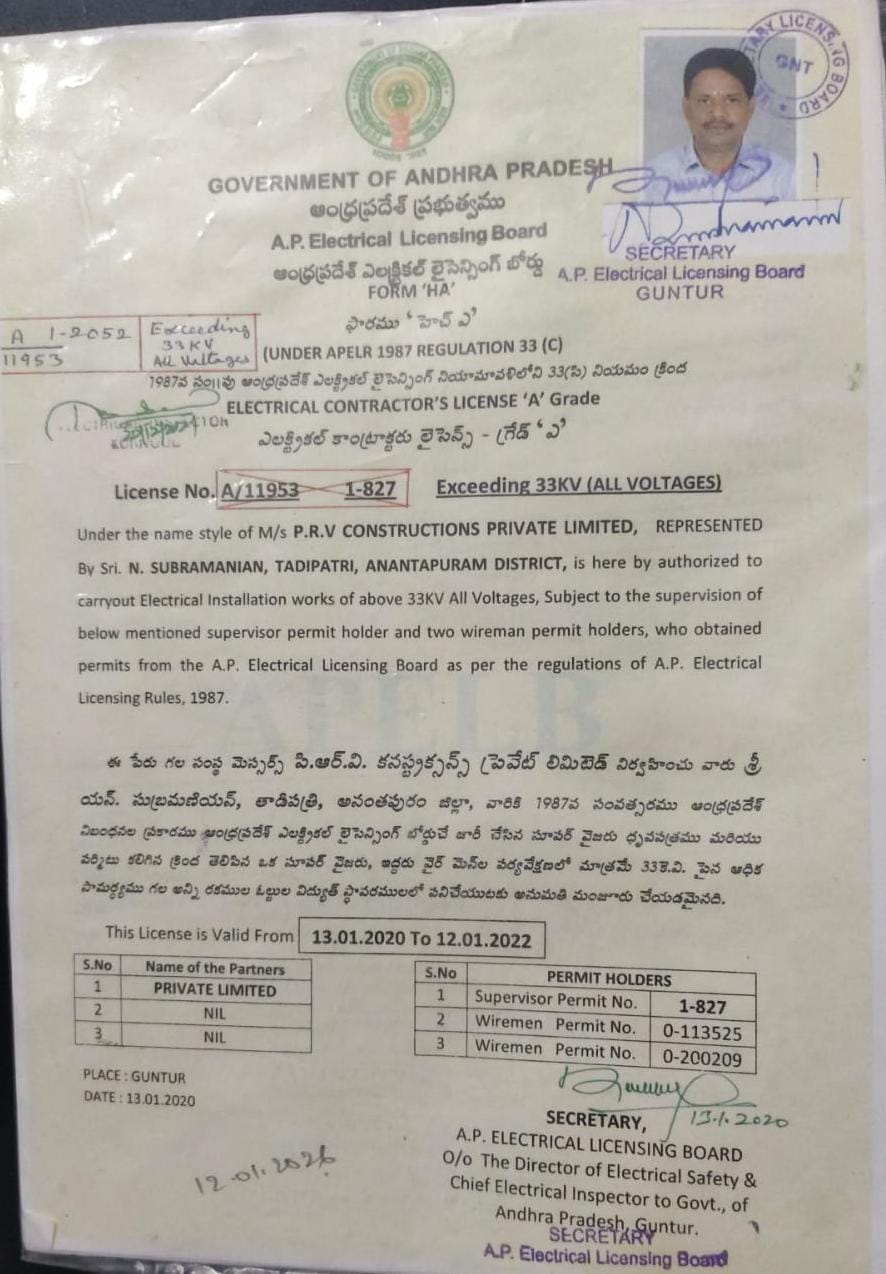
Grade A Electrical Contractor Licence is issued in Form HA and covers extra high voltage, high voltage, medium voltage and low voltage electrical installation works. The voltage level you can actually work on depends on the strength of your supervisor's permit, and the licence is endorsed accordingly. On real APELB licences you will see endorsements such as "Up to 11 KV only", "Up to 33 KV only" or "Exceeding 33 KV (All Voltages)". The recognised voltage slabs are:
- Up to 650 V
- Up to 11 KV
- Up to 33 KV
- Up to 132 KV
- Up to 220 KV
- Exceeding 220 KV
- Mines (restricted and unrestricted)
Grade B Electrical Contractor Licence
Grade B Electrical Contractor Licence is issued in Form HB and covers low and medium voltage installations with a connected load ceiling:
- Up to 50 HP / 37.5 kW where the wireman permit holder does not have an ITI qualification
- Up to 75 HP / 56 kW where the wireman permit holder has an ITI qualification
- Low and medium voltage installations without any load limit, provided the contractor employs a supervisor holding an appropriate competency certificate and permit for direct supervision
In plain terms: house wiring, shops and small commercial loads can run on Grade B, while DISCOM line works, substations, industrial HT connections, solar plants and almost all government electrical tenders require Grade A with the matching voltage endorsement. If you intend to bid APTRANSCO or DISCOM works, check the voltage class specified in the tender before applying, because upgrading the voltage level later is a separate application with its own fee.
Eligibility and Staff Requirements
For a Grade A licence
The applicant, whether an individual, partnership firm or company, must employ:
- One Supervisor holding a Certificate of Competency and an appropriate permit issued by the Board, and
- Two Wiremen holding certificates of competency and permits, or alternatively one Wireman plus one Supervisor Grade 4 (650 V) permit holder
If the applicant personally holds a Supervisor’s Competency Certificate and appropriate permit, there is no need to employ a separate supervisor. In a partnership firm, one of the partners may hold the certificate and permit instead. This is exactly how many proprietor-led firms in Guntur, Kurnool and Anantapur structure their licence.
Three conditions trip up applicants regularly, so read these carefully:
- All wiring staff must be full-time employees, entered in the Register of Employees in Form I. Borrowed or part-time permit holders do not qualify.
- A licence cannot be granted to a competency certificate holder while he is employed with another licensed contractor or anywhere else. The Board checks this through the individual declarations.
- Every Grade A applicant must have an office in the State of Andhra Pradesh, and all Board correspondence goes only to that office. Contractors from other states planning to work in AP need to establish an AP office first.
For a Grade B licence
The applicant must employ one wireman holding a certificate of competency and permit. If the applicant himself is a wireman or Supervisor (Grade 3 or 4) permit holder, no separate employee is needed. The same full-time employmentand non-dual-employment conditions apply.
Testing Instruments You Must Possess
The Board verifies your instrument list before granting the licence, and the instruments must carry valid test certificates. For Grade A, depending on your voltage class, you need:
- One earth resistance megger
- One 1000 V and one 500 V insulation testing megger for licences up to 11 KV
- One 2.5 KV or 5 KV megger in addition to the 1000 V and 500 V meggers for licences up to 33 KV and above (instruments other than the 500 V megger must read up to 0-500 megaohms
- Tong tester or multimeter reading volts, amperes and ohms
- One live line tester
- Standard wire gauge
- First aid box
For Grade B, the list is shorter: a live line tester, standard wire gauge, 500 V insulation testing megger and a tong tester.
Instrument testing itself is a small sub-process. You submit a request letter to the Deputy Electrical Inspector of your sub-division along with a paid challan, listing each instrument with its maker’s name, serial number and range. The Inspectorate tests the instruments and issues the test certificates that go into your licence file. Under Rule 41, the instruments must stay in good working condition throughout the licence period and be produced whenever the Secretary demands them for testing and checking, so this is not a one-time formality.
Documents Required for the Application
The application for both grades is made in Form J to the Secretary, APELB. A complete Grade A file typically contains:
- Filled Form J with full name, business premises address and father’s name
- Partner details and the proposed name and style of the licence
- Details of the supervisor and wiremen: competency certificate numbers and permit numbers
- Original permit books of the supervisor and wiremen, submitted for verification and endorsement by the Board
- Individual declarations from the supervisor and each wireman in the prescribed proforma, confirming full-time employment with the applicant from a stated date
- Name and specimen signature of the person authorised to correspond with the Board
- Details of instruments possessed, with make, serial number and range, plus test certificates
- Original treasury challan for the licence fee
- Mobile number and passport-size photographs (the photo is affixed on the right-hand side of the Form HA or HB licence)
- A note on your contribution to electrical safety, such as safety awareness for farmers, labourers or ITI technicians, which is a distinctive field in the current AP application form
- Details of any other licence already held from APELB
- Register of Employees in Form I
- Self-addressed envelopes with postage stamps at prevailing rates, since the Board dispatches licences and permits by post (two envelopes for fresh licences, one for renewals)
Electrical Contractor Licence Fees in Andhra Pradesh (2025 Rules)
The fee schedule under the 2025 Rules is:
| Purpose | Grade A | Grade B |
|---|---|---|
| Initial licence fee | Rs. 1,000 | Rs. 200 |
| Renewal fee | Rs. 600 | Rs. 150 |
| Duplicate licence | Rs. 200 | Rs. 75 |
| Change of name | Rs. 200 | Rs. 75 |
| Transfer of licence to successor | Rs. 200 | Rs. 75 |
| Late fee for renewal during grace period | Rs. 150 | Rs. 50 |
| Change in voltage or load level | Rs. 500 | Rs. 100 |
| Cost of application form | Rs. 50 | Rs. 30 |
| Continuing the same licence number for a lapsed licence | Rs. 1,000 | Rs. 1,000 |
Related permit fees: grant of competency certificate and permit costs Rs. 150 for supervisors and Rs. 60 for wiremen, and permit renewal costs Rs. 125 and Rs. 50 respectively. Fees are paid by challan into the prescribed government head of account and the original challan is enclosed with the application. Confirm the current head of account with the Inspectorate before remitting, because a challan credited to the wrong head is the single most common reason files bounce.
How to Apply: Step-by-Step Process
- Fix your grade and voltage class based on the work you intend to take up, since this decides your supervisor permit requirement and instrument list.
- Line up your supervisor and wiremen. Verify that their permits are valid and note each permit’s expiry date, because the Board prints these “valid upto” dates on the licence itself and your licence lives or dies with them.
- Procure the required instruments and get them tested through the Deputy Electrical Inspector so the test certificates are ready.
- Pay the licence fee by challan.
- Compile the Form J file with declarations, original permit books, instrument certificates, challan, photographs and envelopes.
- Submit the file to the Secretary, A.P. Electrical Licensing Board, Guntur.
- The Secretary scrutinises the application, and defective or incomplete files are liable to be rejected outright, so completeness at first filing matters.
- On approval, the licence is issued in Form HA (Grade A) or Form HB (Grade B) with your photograph, licence number, voltage endorsement, validity dates and the permit holder table, and dispatched in your self-addressed envelope.
The 2025 Rules do not prescribe a statutory processing timeline. In practice, a documents-complete file moves through in roughly four to twelve weeks depending on verification and the Board’s internal schedule, while files with permit discrepancies or missing test certificates can sit for months. The Tender & Licence team’s standard approach is to resolve every permit validity and instrument issue before filing, precisely because post-submission clarifications are slow in a physical-file system.
Validity, Renewal and Late Fees
Every electrical contractor licence in Andhra Pradesh is valid for two years and renewed once in two years. The renewal application is made in Form N and must be submitted within the 90 days before the expiry date, enclosing:
- The expiring licence
- Individual declarations from all employees confirming continued full-time service, countersigned by the contractor
- Challan for the renewal fee
- Register of Employees
- A declaration regarding the instruments
If you miss the expiry date, the rules allow renewal up to 90 days after expiry on payment of the late fee (Rs. 150 for Grade A, Rs. 50 for Grade B). Beyond that 90-day grace period, the licence stands cancelled and a fresh licence has to be obtained. The one softener is that the Board permits continuing your old licence number on a lapsed licence against a fee of Rs. 1,000, which matters if your licence number is quoted in running contracts and DISCOM registrations.
Suspension and Cancellation: The Traps to Watch
Rule 38 is printed as a warning note on the face of every AP licence, and for good reason. Your licence is deemed suspended forthwith if:
- The supervisor or wireman on whose permit strength the licence was granted leaves your service, or
- Any supervisor or wireman permit lapses after the grant or renewal of your licence
From the date of such suspension you get one month to employ a replacement permit holder or get the lapsed permit renewed. If that does not happen within the month, the licence stands cancelled. A contractor’s licence issued to a partnership firm also stands cancelled immediately on any change in the partnership, and the licence is not transferable, except that on the death of a proprietor or partner the legal successor can have it altered within six months on producing a succession certificate, with the death intimated to the Secretary within one month.
The practical discipline this demands is simple: maintain a diary of every permit expiry date on your licence and start permit renewals early. A large share of the emergency cases that reach Tender & Licence are contractors whose wireman’s permit quietly expired mid-tenure, which suspended a perfectly good licence in the middle of running DISCOM works.
Supervisor Competency Certificate and Permit in AP
Since the whole licence rests on permits, here is the current framework in brief. The supervisor examination is conducted by the State Board of Technical Education and Training, AP on behalf of the Director of Electrical Safety and CEIG, with written papers plus practical and oral components, and applications are made online through the SBTET portal when notifications open.
- Eligibility: 10th class pass with 8 years of experience in electrical installation works, or an ITI wireman or electrician certificate holder with 4 years of experience. Minimum age is 20 years. Separate mines variants exist with underground and opencast experience conditions.
- Exemption from the examination: holders of a Degree in Electrical Engineering with one year of practice, or a Diploma with two years, are exempted. ITI or SSC route candidates who pass the supervisor examination initially receive a 650 V permit, upgradeable up to 33 KV with work experience in line with graduate and diploma engineers.
- Permits are valid for 5 years and renewable for further 5-year blocks. Renewal applications go in before expiry, with a 90-day grace period on late fee (Rs. 100 per year for supervisors). Beyond the grace period the permit is treated as lapsed and a fresh permit is issued with penalty. Candidates above 65 years need a medical fitness certificate for renewal.
- Permit holders must also hold a recognised training certificate in Power Medicine and First Aid, and must carry the permit at the work site for spot scrutiny.
For wiremen, the examination is practical plus oral, eligibility is 4 years of certified experience with a minimum age of 18, and candidates who have passed a recognised ITI wireman or electrician trade examination with one year of experience are exempted. Wireman permits follow the same 5-year validity cycle, with a late fee of Rs. 50 per year during grace.
Supervisor certificates and permits issued by other states can be recognised in AP under reciprocal arrangements on payment of a Rs. 300 recognition fee, with the recognition endorsement made on the permit.
Compliance After You Get the Licence
The licence brings continuing obligations that inspectors actually check:
- Every electrical contract must be in writing and signed by both parties, producible before the Secretary on demand.
- A work commencement report in Form WR-1 is filed immediately before starting each work, and a completion-cumtest report in Form WR-2, filled and signed by the supervisor or wireman and the contractor, is filed on completion. The DISCOM releases supply only against the WR-2.
- The Register of Employees in Form I must be maintained and kept open for inspection, and every appointment or termination of a supervisor, wireman or apprentice must be reported to the Secretary with permit numbers and joining declarations.
- Apprentices cannot exceed the number of your certified wiring staff.
- All correspondence with the Board must go under the specimen signatures lodged with the Secretary.
- All work must conform to the Electricity Act, 2003 and the CEA (Measures relating to Safety and Electric Supply) Regulations, 2023, with the contractor and the supervisor or wireman jointly responsible for the quality of work and materials.
Where the Work Is: Electrical Contracting Across Andhra Pradesh
The demand map for licensed contractors in AP is broad. Visakhapatnam anchors heavy industry, port infrastructure and IT campuses on the east coast, with APEPDCL network works running through the district. The Vijayawada and Guntur belt, together with the Amaravati capital region construction programme, generates continuous building services and HT connection work under APCPDCL. Tirupati and Sri City host one of south India’s fastest growing electronics manufacturing clusters, served by APSPDCL, while Kakinada and Nellore (Krishnapatnam) add port-led industrial loads. Kurnool and Anantapur sit at the centre of the state’s solar and wind park corridor, where developers routinely require Grade A contractors with 33 KV and above endorsements. Rajahmundry, Eluru, Ongole, Vizianagaramand Chittoor round out steady municipal, housing and MSME wiring demand. Whichever region you operate in, the licence and its voltage endorsement decide which of these opportunities you can legally bid.
How Tender & Licence Supports Your APELB Application
Tender & Licence assists electrical contractors across India with state licensing, and our Andhra Pradesh service covers the complete APELB cycle:
- Grade and voltage class assessment against the works you actually intend to bid
- Verification of supervisor and wireman permits, including validity checks and renewal coordination before filing
- Instrument checklist for your voltage class and coordination of instrument testing with the Electrical Inspectorate
- Preparation of the Form J application, declarations, Form I register and enclosures
- Challan guidance, filing with the Secretary, APELB Guntur, and follow-up until dispatch
- Renewals in Form N, late-fee cases within the grace window, change of name, voltage upgrades and succession transfers
To be transparent about scope: we do not appear in or clear SBTET competency examinations on anyone’s behalf, we do not supply supervisors or wiremen as manpower, and we cannot revive a licence that has crossed the 90-day grace period, in which case we prepare the fresh application honestly rather than promising a shortcut. If your supervisor or wireman permits are the weak link, we tell you that before you spend money on the contractor licence file.
We already support contractors with electrical contractor licences in Uttar Pradesh, Delhi, Maharashtra and Gujarat, along with allied requirements such as GeM registration, tender documentation and ISO certification, so multi-state contractors get one coordinated compliance desk. If you are planning an Andhra Pradesh electrical contractor licence application, renewal or a voltage upgrade, reach out to the Tender & Licence team and we will map your fastest compliant route.
- Frequently Asked Questions
How do I apply for an electrical contractor licence in Andhra Pradesh?
Prepare the application in Form J with your supervisor and wireman permit details, instrument test certificates, fee challan and declarations, and submit the physical file to the Secretary, A.P. Electrical Licensing Board, Guntur. Forms are available on the CEIG AP website, but there is no online application for the contractor licence itself.
What is the fee for an electrical contractor licence in AP?
Under the 2025 Rules, the initial fee is Rs. 1,000 for Grade A and Rs. 200 for Grade B, paid by treasury challan. Renewal costs Rs. 600 and Rs. 150 respectively.
What is the validity of the licence and how is it renewed?
The licence is valid for two years. Renewal is filed in Form N within the 90 days before expiry, with the expiring licence, employee declarations, challan, employee register and instrument declaration.
What is the difference between Grade A and Grade B electrical contractor licences?
Grade A covers low to extra high voltage works depending on the supervisor permit strength and is required for HT, substation, DISCOM and most government works. Grade B covers low and medium voltage installations with connected load limits of 50 HP or 75 HP, or without load limit if a supervisor is employed.
Can I apply for the AP electrical contractor licence online?
No. As of now the contractor licence is a physical, challan-based application at APELB Guntur. Only the SBTETsupervisor and wireman examinations are applied for online.
Is an office in Andhra Pradesh mandatory?
Yes for Grade A. Every applicant or holder must have an office in the state, and all Board correspondence is made only to that office.
What happens if my supervisor resigns or a permit expires?
The licence is deemed suspended immediately. You have one month to employ a replacement permit holder or renew the lapsed permit, failing which the licence stands cancelled.
My licence expired four months ago. Can I still renew it?
No. The grace period for renewal with late fee is 90 days after expiry. Beyond that the licence stands cancelled and a fresh licence must be obtained, though the Board allows retaining the old licence number on payment of Rs. 1,000.
Are licences issued under the 1987 Regulations still valid?
Yes. The 2025 Rules contain a savings clause, so licences and permits issued under the 1987 Regulations continue to be valid and are simply renewed under the new rules.
Will my supervisor permit from another state work in Andhra Pradesh?
Only where a reciprocal arrangement exists between AP and that state. Recognition is endorsed on the permit on payment of a Rs. 300 fee, and the holder becomes subject to the AP rules.