
Electrical Contractor License in Delhi
Delhi Electrical Contractor License at a Glance
Starting @ ₹29,999 Only
Anyone doing electrical installation, wiring or maintenance work in Delhi needs an Electrical Contractor License. It does not matter whether the work is residential, commercial or industrial. Without this license, you are operating illegally. And the consequences are serious. Under Section 146 of the Electricity Act, 2003, you can face up to 3 months of imprisonment or a fine of up to Rs 1,00,000 or both.
Now here is where things get interesting. Delhi does not follow the same licensing system as most other Indian states. You will not find Class A, Class B or Class C categories here. Delhi has its own structure, and a surprising number of websites get it completely wrong. Some consultants even charge extra saying they will “get you a Class A license” in Delhi, which is simply not a real thing.
We have helped clients through this process and seen the actual license documents. So in this guide, we are going to walk you through how the system actually works, not how other websites think it works.
Why Delhi Is Different: No Class A, B or C License
Let us get this out of the way first because this is the root cause of most confusion.
States like Uttar Pradesh, Andhra Pradesh, Rajasthan and Karnataka classify their electrical contractor licenses into different grades. Class A handles high-tension unlimited works, Class B covers medium-voltage, Class C is for low voltage installations, and so on. Each class has its own eligibility criteria, separate fees and a defined scope of work.
Delhi does none of that.
The Electrical Inspectorate under the Labour Department, Government of NCT of Delhi, issues just one type of Contractor License. Its scope is unlimited. You can do domestic house wiring with it and you can do high-voltage industrial installations with it. There is no voltage ceiling and no project value cap.
What Delhi does have is a separate competency certificate system that runs alongside the contractor license.
Certificate of Competency Class-I (Electrical Supervisor) is meant for qualified individuals who supervise electrical installation work. Your firm needs at least one Class-I holder on payroll before you start any project.
Certificate of Competency Class-II (Electrician) is meant for the people who actually do the wiring and installation. You need at least two Class-II holders employed with your firm.
The whole framework runs under Notification No. ED4(Misc-38)/Lab-EI/2016/381 dated 27.01.2017. The competency certificates are issued by the Board of Examiners, which is chaired by the Electrical Inspector of Delhi.
Think of it this way. The Contractor License (issued as Form No-B) goes to your firm. Once you have it, you hire Class-I and Class-II certificate holders. Then you are ready to take on projects.
Who Can Apply?
For the Contractor License
You do not need any specific educational qualification to apply for the contractor license. The license goes to the business entity, whether that is a proprietorship, partnership firm, LLP or private limited company.
But there are certain conditions, and the address requirement is where most people trip up.
Delhi address is mandatory. The exact requirement changes depending on your entity type, and this is something almost no guide on the internet explains properly.
If you are running a proprietorship firm, both your Aadhaar Card and your GST Registration need to show a Delhi address. Not one or the other. Both. They do not need to be the same address though. For example, your Aadhaar can show Malviya Nagar, Delhi and your GST can show Vikas Nagar, Delhi, and that is perfectly fine. What will not work is if your Aadhaar says Lucknow and your GST says Delhi, or the other way around. Both documents must be Delhi-based. If you have not done your GST registration yet, get that sorted first.
For a private limited company, LLP or OPC, the company’s GST Registration must be Delhi-based. That part is non-negotiable. But there is some flexibility on the address. It does not have to be in a Director’s name specifically. The office can be registered under any authorised person’s name. As long as the GST certificate shows a Delhi address, you are good.
For a partnership firm, you need both pieces. The firm’s GST Registration should have a Delhi address, and at least one partner’s Aadhaar Card must also show a Delhi address. Having only the GST in Delhi but no partner with a Delhi Aadhaar can cause issues during verification.
Understanding these three scenarios will save you from most application rejections right away.
Beyond the address, here is what else you need:
An office or showroom in Delhi that is accessible to the public. It should ideally be in a commercial or market area.
Testing instruments including Insulation Tester (Megger), Earth Resistance Tester, Volt-Meter, Am-Meter and Multimeter. These need to be in working condition, and you must have the original purchase receipts.
Electrical materials should be stocked at your premises, again with purchase receipts.
For Class-I Certificate (Electrical Supervisor)
There are three routes to eligibility here.
The first is to already hold a Class-II certificate and then gain at least 5 years of practical wiring experience after that.
The second is to hold a recognised Degree in Electrical Engineering and complete 1 year of practical training after the degree.
The third is to hold a recognised Diploma in Electrical Engineering and complete 3 years of practical training after the diploma.
In all cases, the applicant must be a Delhi NCT resident. The Board of Examiners conducts an examination to assess your practical knowledge before issuing the certificate.
For Class-II Certificate (Electrician)
You need either 2 years of practical wiring experience, or an ITI pass from a Delhi NCT-recognised institute in the Electrician or Wireman trade, or completion of a 3-year Apprenticeship Course through Delhi's Apprenticeship Advisor in the Lineman, Wireman or Electrician trade.
Minimum age is 18 years.
Here is a useful detail. If your ITI is from a Delhi-recognised institute, you skip the exam entirely. The certificate is issued directly after document verification. Candidates from outside Delhi will generally need to appear for the examination.
Note : Both Class-I and Class-II certificates stay valid until the holder turns 65.
One Thing Most Guides Get Wrong - When to Hire Technicians
This is worth calling out because we see the same mistake repeated everywhere online.
Most websites tell you that you need to hire Class-I Supervisors and Class-II Electricians before applying for the contractor license. That is not how it actually works.
The contractor license is issued to your firm based on your entity documents, address proof, GST and fee payment. You get the license first.
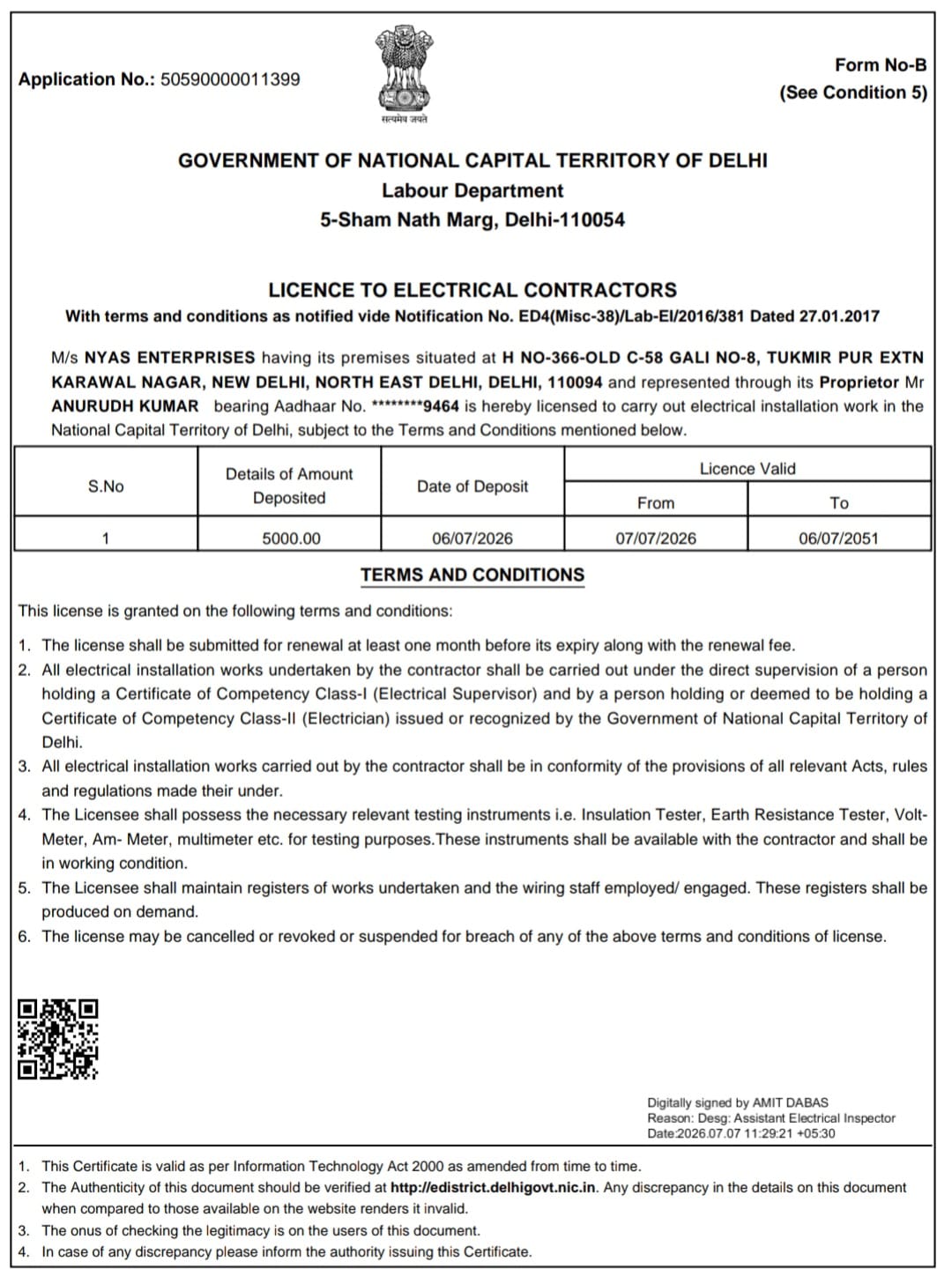
Now, the issued license (Form No-B) carries a set of terms and conditions. Condition No. 2 on the license says that all electrical installation work must be carried out under the direct supervision of a Class-I holder and by Class-II holders issued or recognised by the Government of NCT of Delhi.
What this means in practice is straightforward. Get the license first. Then, before you take on any project, hire your qualified technicians. The hiring is a post-license, pre-work requirement. Not a pre-application requirement.
This distinction matters because many first-time applicants waste months trying to find and hire certified electricians before they even file their application. You do not need to do that. Get your paperwork in order, get the license, and then build your team.
Documents Required
For the Contractor License Application
Filled application form (download from labour.delhi.gov.in)
Delhi address proof based on entity type (Aadhaar and/or GST as explained above)
Office or showroom occupancy proof (rent agreement or ownership documents)
Electricity bill of the office premises
GST Registration Certificate with Delhi address
List of testing instruments with original purchase receipts
List of electrical materials with purchase receipts
Partnership deed or Certificate of Incorporation with MOA/AOA
Authorisation letter
PAN Card
Passport-size photographs (attested)
Treasury Challan receipt or online payment receipt of Rs 5,000
For Class-I Certificate (Form A, Annexure C)
For Class-II Certificate (Form A, Annexure D)
Electrical Contractor License in Delhi
Online Application Process | e-District Portal
Register & Log In
Create your account on edistrict.delhigovt.nic.in with your mobile number and email, then log in.
Select the Service
Find 'Grant of Electrical Contractor's License' under the Labour Department services.
Fill the Application
Enter the applicant, entity and Delhi address details in the application form.
Upload Documents
ID and address proof, entity papers, instrument purchase receipts and the undertaking.
Pay the Fee - Rs 5,000
Pay the government fee online through the portal and save the payment receipt.
Verification & License Issued
The Electrical Inspectorate verifies the file. License issued in Form No-B, valid 25 years.
Fees and Validity - Where Most Websites Get It Wrong
This needs to be said clearly because there is a lot of wrong information out there. Multiple websites state that the Delhi Electrical Contractor License has a validity of just 3 years. That is incorrect.
We have seen actual licenses issued by the department. A license issued on 15/04/2026 carries a validity date of 14/04/2051. Count it out. That is exactly 25 years.
Here is the complete fee and validity breakdown:
| Item | Fee (Rs) | Validity |
|---|---|---|
| Contractor License - New | 5,000 | 25 years |
| Contractor License - Renewal | 2,500 | 10 years |
| Contractor License - Duplicate | 1,000 | - |
| Contractor License - Amendment | 1,000 | - |
| Class-I Supervisor Exam Fee | 250 | Up to age 65 |
| Class-II Electrician Exam Fee | 100 | Up to age 65 |
For context, in Uttar Pradesh you have to renew your electrical contractor license every single year by 31st March. In Maharashtra, the validity is just 3 years. Delhi giving you 25 years of validity is a massive advantage. Once you have it, you are sorted for a quarter of a century.
Payment can be made through a Treasury Challan at State Bank of India, Old Secretariat, Delhi, or through online e-payment.
How to Apply - Step by Step
The Tender & Licence team follows a structured process for every Electrical Contractor License application in Delhi.
Get Your Entity Documents in Order
Before you fill any form, make sure your business entity is registered and your Delhi address proof is sorted. Check the Aadhaar-GST combination based on your entity type as explained earlier. This single step prevents most rejections.
Set Up Your Office and Buy Equipment
Get your office or showroom ready in a publicly accessible location in Delhi. Buy the mandatory testing instruments. Keep the original purchase receipts because the department will ask for them. Stock some basic electrical materials as well.
Fill the Application Form
Download the form from the Delhi Labour Department website. Fill every field. Do not leave anything blank. Attach all supporting documents.
Pay the Fee
Pay Rs 5,000 through Treasury Challan at SBI, Old Secretariat, Delhi, or make an online payment. Keep the receipt safe.
Submit Your Application
Take the complete set (form, documents, payment receipt) and submit it at the Office of the Assistant Electrical Inspector, Labour Department, Government of NCT of Delhi at 5-Sham Nath Marg, Delhi-110054.
Wait for Verification and Issuance
The department will verify your documents. Officially, the license should be issued within 7 working days if everything is complete. Practically, it takes anywhere from 15 to 45 days depending on how busy the office is.
The license comes as Form No-B, digitally signed by the Assistant Electrical Inspector. You can verify it online at
edistrict.delhigovt.nic.in
Hire Your Technicians
With the license in your hand, go ahead and hire at least one Class-I Supervisor and two Class-II Electricians. Get their consent letters ready and maintain a proper staff register. Now you are legally ready to start taking on electrical projects.
What This License Opens Up for Your Business?
Getting a contractor license is not just about avoiding penalties. It genuinely changes what your business can do.
Government tenders become accessible. PWD, CPWD, DDA, NDMC, DMRC, Delhi Jal Board and practically every government body in Delhi requires a valid contractor license before you can bid on electrical tenders. Without one, your bid gets rejected at the eligibility stage itself.
Private clients take you seriously. Builders, real estate developers and corporate clients increasingly check for a valid license before awarding contracts. Insurance companies verify it too.
You get legal protection. If an electrical accident happens and you have followed all safety protocols, a valid license protects you legally. Without one, you are looking at criminal liability on top of everything else.
Bank financing becomes easier. Project loans, performance guarantees and bank financing all require a contractor license as a supporting document.
What Happens If You Work Without a License?
Under Section 146 of the Electricity Act, 2003, the penalties are clear. Up to 3 months imprisonment, or a fine of up to Rs 1,00,000, or both. On top of that, you can be blacklisted from government tenders, your ongoing projects can be stopped, and if there is an accident, separate criminal proceedings will follow.
It is not worth the risk.
How to Modify Your License?
Business circumstances change. You might shift your office, convert from a proprietorship to a partnership, or change your firm’s name. All of this can be handled through an amendment.
Submit your original license with a written application explaining the changes to the Assistant Electrical Inspector. Pay Rs 1,000 as the amendment fee via Treasury Challan or online. After verification, the department will issue an updated license.
Renewal Process
With 25 years of validity, renewal is not something you will think about anytime soon. But for completeness, here is how it works.
Apply at least one month before the license expires. Submit the renewal form along with your original license. Provide an updated staff register showing all your current supervisors and electricians with valid certificates. Demonstrate that your testing instruments are still available and working. Pay Rs 2,500 as the renewal fee. The renewed license is valid for another 10 years.
For competency certificates, the renewal fees are Rs 100 per year for Class-I and Rs 50 per year for Class-II. These are renewed in blocks of 10 years.
Getting a Duplicate License
If your license gets lost or damaged, file an FIR reporting the loss first. Then fill out an application for a duplicate license, pay Rs 1,000, and submit everything (FIR copy, application, payment receipt) at the Labour Department. A duplicate license will be issued after verification.
Contractor License vs Competency Certificate - Quick Comparison
These two get mixed up a lot, so here is the simplest way to understand the difference.
| Contractor License | Competency Certificate | |
|---|---|---|
| Issued to | Firm or company | Individual person |
| Purpose | Run an electrical contracting business | Supervise or do electrical work |
| How many per firm | 1 | Minimum 1 Class-I + 2 Class-II |
| Validity | 25 years | Up to age 65 |
| Fee | Rs 5,000 | Rs 100 to Rs 250 |
| Form | Form No-B | Issued by Board of Examiners |
The license is for the business. The certificate is for the person. The business gets the license and then hires certified people to do the work.
Where to Apply and Contact Details?
Department: Electrical Inspectorate, Labour Department, Government of NCT of Delhi
Head Office Address: 5-Sham Nath Marg, Delhi-110054
Headed by: Chief Electrical Inspector
License signed by: Assistant Electrical Inspector
Application Form: labour.delhi.gov.in
License Verification: edistrict.delhigovt.nic.in
Fee Payment: State Bank of India, Old Secretariat, Delhi (or online e-payment)
Mistakes to Avoid
Assuming Delhi has a class system. It does not. There is one license. If someone is selling you a "Class A license for Delhi," they do not understand the system.
Aadhaar or GST not from Delhi. For proprietorships and partnerships, both Aadhaar and GST need to be Delhi-based. They can be different addresses within Delhi, but both must be Delhi. Having one from another state is the number one reason applications get held up.
Not keeping instrument receipts. Having the instruments is not enough. You need the original purchase receipts.
Applying with only an out-of-state address. At least one key document (Aadhaar for proprietors/partners, GST for companies) must show a Delhi address.
Leaving fields blank on the form. Every single field needs to be filled. Incomplete forms get rejected outright.
How Tender & Licence Helps You Get the Delhi License
The Tender & Licence team files Delhi applications with the Electrical Inspectorate of the Labour Department, Govt. of NCT of Delhi, and our Gurugram office keeps the capital within easy working distance. Delhi runs on its own system: the Inspectorate looks at your technical staff, your premises in the NCT, and the completeness of your file. Timelines sit with the department; a correct and complete file is what we control, and that is what we deliver.
- Confirm eligibility before any fee is paid: premises in Delhi, a Certificate of Competency Class-I holder as supervisor, and Class-II qualified wiremen on your rolls
- Arrange supervisor and wireman competency certificates if your staff does not hold them yet
- Build the complete file: staff records, testing instrument list, undertakings, photographs, and fee challan
- Submit the application to the Electrical Inspectorate through the Delhi e-District portal
- Answer department queries and prepare you for the verification stage so the file keeps moving
- Follow up till the license is issued, not just submitted
- Handle renewal before expiry, and amendments when your address, staff, or firm constitution changes
- Run reminder cycles so an expiry date never catches you mid project
A Delhi license is the entry requirement for PWD, CPWD, DDA, MCD, NDMC, and DMRC electrical works, and those tenders usually ask for more than the license alone. The same desk that files your license can also complete Wireman and Supervisor competency certificates, IREPS railway tender registration, CPWD vendor registration, GeM registration, UP state tender filing, and supporting registrations like MSME, Digital Signature, Trademark, GST Registration, ISO and BIS certifications. Contractors taking projects beyond the capital can start with our page on the Electrical Contractor License in UP, Electrical Contractor License in Maharashtra. One consultant, every registration an electrical firm needs.
- Frequently Asked Questions
What is the validity of an Electrical Contractor License in Delhi?
25 years from the date of issue. We have verified this from actual licenses where a license issued on 15/04/2026 shows validity till 14/04/2051. Some websites incorrectly say 3 years, but that applies to states like Maharashtra, not Delhi.
Does Delhi have Class A, Class B or Class C licenses?
No. Delhi has a single Electrical Contractor License with unlimited scope. There is no voltage-based or project-valuebased classification.
Do I need to hire electricians before applying?
No. You get the license first. After receiving it, you must hire at least one Class-I Supervisor and two Class-II Electricians before starting any project. This is a condition of the license, not a condition of the application.
How much does the license cost?
Rs 5,000 for a new license. Payment can be made via Treasury Challan at SBI, Old Secretariat, Delhi, or through online e-payment.
Is a Delhi address compulsory?
Yes. The exact requirement depends on your entity type. Proprietors need both Aadhaar and GST to be Delhi-based, though they can be different Delhi addresses. Companies need their GST to be Delhi-based. Partnerships need the firm’s GST and at least one partner’s Aadhaar to show a Delhi address.
Can supervisors from other states work under a Delhi license?
The license specifies that work must be supervised by certificate holders issued or recognised by the Government of NCT of Delhi. Certificates from other states may require endorsement or a fresh exam.
Does a Class-II applicant need to give an exam?
If you have an ITI from a Delhi-recognised institute in the Electrician or Wireman trade, no exam is needed. The certificate is issued after document verification. Others will need to appear for the Board of Examiners examination.
How long does it take to get the license?
Officially 7 working days. Practically 15 to 45 days depending on the department workload.
Can I use my home address as the business premises?
The department expects a business premises like an office or showroom in a publicly accessible location. A residential address is generally not accepted.
What instruments are mandatory?
Insulation Tester (Megger), Earth Resistance Tester, Volt-Meter, Am-Meter and Multimeter. All must be in working condition with original purchase receipts.
What are the penalties for working without a license?
Under Section 146 of the Electricity Act, 2003, you can face up to 3 months imprisonment, or a fine up to Rs 1,00,000, or both. You can also be blacklisted from government tenders.
Can I amend the license if my firm structure changes?
Yes. Submit the original license with an application explaining the changes and pay Rs 1,000 as amendment fee.
Is the Delhi license valid in other states?
No. It is valid only within the National Capital Territory of Delhi. For work in other states, you need a separate license from that state’s electrical inspectorate.
What records must a licensed contractor maintain?
Registers of all works undertaken and all wiring staff employed or engaged. These must be produced on demand during inspections.